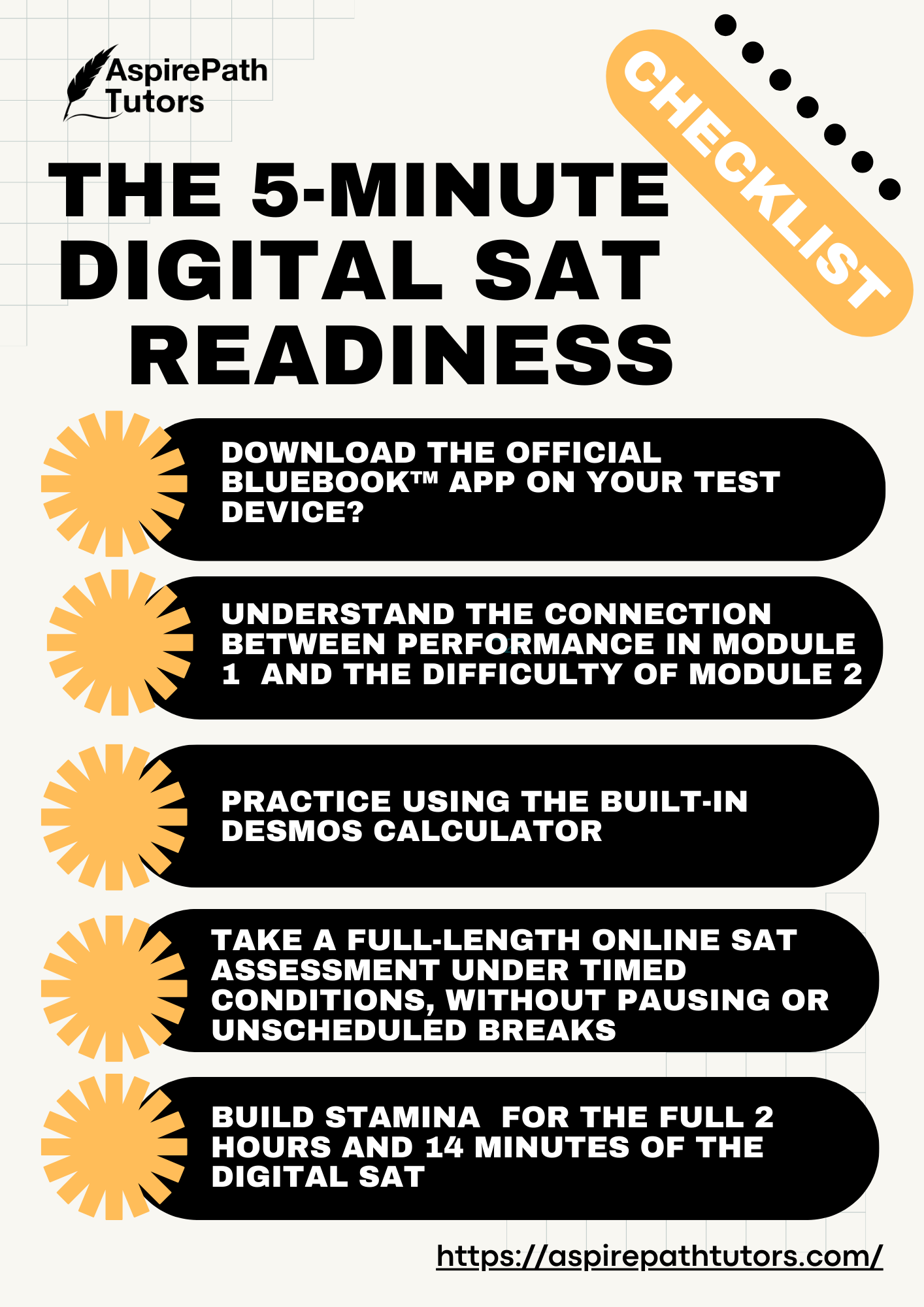
Are You Ready for the Digital SAT?
Use This Simple 5-Minute Checklist
The SAT isn’t just a test of what you know — it’s a test of what you can do under pressure. Most students don’t lose points because the questions are “too hard.” They lose points because the clock wins.
At AspirePath Tutors, we teach students to flip the script. As leadership author, Peter Drucker famously noted, “Time is the scarcest resource; unless it is managed, nothing else can be managed.”
Mastering time on the SAT is one of the best SAT prep strategies you can employ — and it can raise scores dramatically, even without learning new content. This guide breaks down section-by-section, fact-based time management methods proven to help students finish on time, stay calm, and score higher — especially on the Digital SAT.

The Digital SAT isn’t just a shorter version of the old test, it demands digital fluency alongside academic skill.
Many students who performed well on paper struggle initially because:
– Screen-based reading changes pacing
– Adaptive modules reward consistency, not guessing
– Calculator efficiency matters more than ever
A tutor-led SAT readiness test can help determine whether a student’s challenges are content-based (Algebra, grammar, reading comprehension) or format-based (timing, digital navigation, adaptive strategy).
At AspirePath Tutors, our approach emphasizes mastering both the content and the digital test environment.
College admissions timelines move fast and SAT readiness plays a critical role. Whether your child is just starting out or aiming to improve their score by the final 100 points, expert guidance makes a measurable difference.
Explore our Online SAT Tutoring Service to see how AspirePath Tutors tailors preparation for the Digital SAT format.
Or Book a Free Consultation to receive a personalized readiness assessment and study plan.
The Digital SAT is a computer-based exam taken on a laptop or tablet. It is shorter, section-adaptive, and includes a built-in graphing calculator for math. While the content remains similar, the test experience and strategy are very different, which is why preparation must be adapted to the new format.
Neither — it’s different. Some students benefit from the shorter duration and calculator access, while others struggle with screen-based reading, timing, and adaptive modules. Success depends less on raw ability and more on digital strategy and consistency.
The Digital SAT adjusts difficulty after the first module.
If a student performs well in Module 1, they unlock a more challenging Module 2, which offers access to higher score ranges. This means early accuracy matters more than ever.
A quick way to assess readiness is by using a Digital SAT readiness checklist. It helps identify whether a student is:
This distinction is critical for effective preparation.
Yes — very commonly. Many high-achieving students lose points due to:
That’s why digital test strategy is now as important as academic knowledge.
Students can take the SAT multiple times per year, and colleges typically superscore — meaning they consider the highest section scores across attempts. Strategic preparation before each attempt is key to maximizing results.
Preparation timelines vary, but most students benefit from 8–16 weeks of structured prep. Students aiming for competitive score improvements (especially the final 100 points) often need targeted, tutor-guided strategy rather than general practice alone.
Official tests are essential, but practice without analysis leads to plateaus. Students need help interpreting results, identifying patterns, and developing a Module 2 strategy to translate practice into real score gains.
Ideally:
Starting earlier allows time to master both content and digital execution without stress.
AspirePath Tutors focuses on:
The goal is not just practice — it’s precision improvement.